Perfect Albums series
Crosby, Stills, Nash & Young
Déjà VuThe story and the copies worth owning
Published
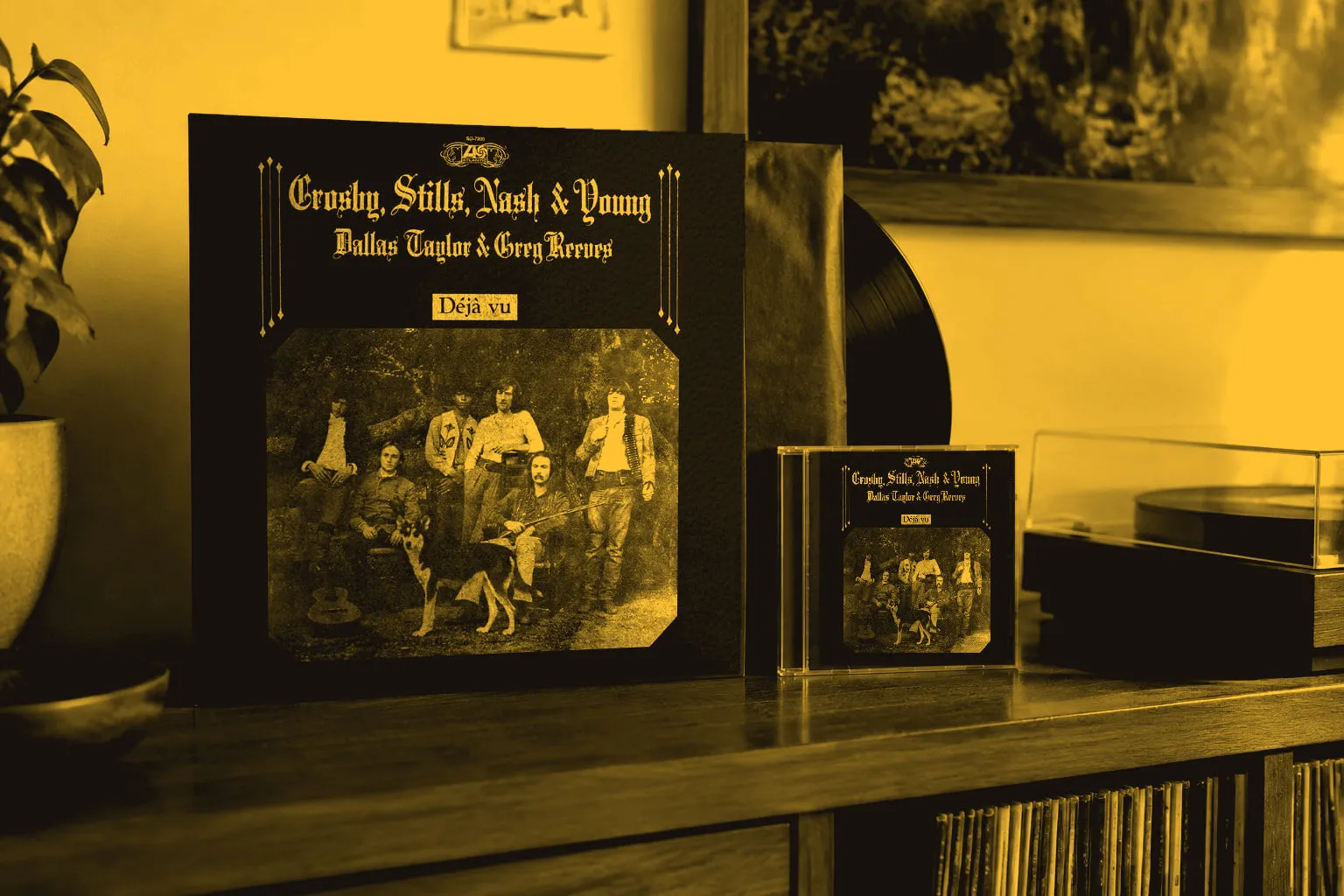
Déjà Vu should not work. Four songwriters who could barely stand to be in the same room made it mostly in shifts, one at a time, over six months of late nights. One of them was grieving. Two of them had already fought their way out of one band together. And yet the record they left behind runs ten songs without a weak one, from the first chord of “Carry On” to the last of “Everybody I Love You”.
What kind of record it is
Déjà Vu is the Laurel Canyon sound at full strength: folk songs with a rock band under them, country played by people who had grown up on it second-hand, and three or four voices stacked so tightly they read as one instrument. Call it folk rock if you need a shelf for it. The shelf does not explain why the harmonies land the way they do.
The trick is range. Inside forty minutes the record moves from the acoustic rush of “Carry On” to a lone guitar on “4 + 20”, from the pedal steel on “Teach Your Children” to the two electric leads snarling through “Almost Cut My Hair”, from the hymn-slow “Helpless” to the orchestrated suite of “Country Girl”. Four writers meant four palettes, and the harmonies are what make it one album rather than an anthology.
That combination, confessional songs sung in immaculate harmony over a studio-crafted band, set the pattern for much of what followed from California in the 1970s. The Eagles, Jackson Browne and the later Fleetwood Mac are regularly named as its descendants. Whether or not you want to credit one record with a decade, this is the one people point to.
Four people, one room, rarely at once
Crosby, Stills & Nash had released their debut in 1969 and needed another guitarist to play it live. They chose Neil Young, the same man Stephen Stills had fought with in Buffalo Springfield. Stills thought it would be different this time.
The quartet first played together on 15 July 1969 at a house Stills was renting from Peter Tork of the Monkees in Studio City. The album proper was recorded between July 1969 and January 1970 at Wally Heider’s Studio C in San Francisco and his Studio 3 in Hollywood, with Dallas Taylor on drums and Greg Reeves on bass. Stills later claimed the record took around 800 hours of studio time. Nobody has confirmed the figure, but nobody who was there has called it absurd either.
What the hours bought was not togetherness. Most songs were built as sessions led by their writer, with the others adding parts. Graham Nash recorded some of his separately in Los Angeles and brought the tapes in. Young appears on only five of the ten tracks. Taylor, Reeves and engineer Bill Halverson have all said the first album was made with enthusiasm and this one with the musicians butting heads.
The mood had reasons. David Crosby’s girlfriend Christine Hinton died during the sessions. Nash has said the group’s relationships were coming apart around them. You can hear it. Déjà Vu never sounds like a band enjoying its success. It sounds like four people holding on to something before it goes.
The songs, and what it took to get them
- “Carry On” was the last thing recorded, because Nash pointed out the album still had no opener. Stills took “Questions”, a song he had written for Buffalo Springfield, welded it to another unfinished piece and a jam from a few days earlier, and had a finished master in about eight hours by his own account. It is the fastest song on the album and the one that sounds most like a band.
- “Teach Your Children” was nearly a music-hall number. Nash’s first idea was in the style of “I’m Henry VIII, I Am”; Stills turned it toward country. The pedal steel is the Grateful Dead’s Jerry Garcia, who had taught himself the instrument and spliced his part together from several takes. His fee was a trade: in return, CSNY would coach the Dead’s vocal harmonies for their next albums.
- “Almost Cut My Hair” was cut on 9 January 1970 with everyone in the room at once, which is rare on this record. Stills and Young both play lead. Stills did not want the song on the album; Crosby kept it there over his objection. The 2021 box holds a ten-minute alternate where the two guitarists simply refuse to stop.
- “Helpless” is Young’s memory of Omemee, Ontario, and the polio he caught there at five. He had already tried it with Crazy Horse. CSNY tried it many ways before settling on the slow version, recorded on 7 November 1969, with Young alone on the verses and the others arriving for the chorus.
- “Woodstock” is Joni Mitchell’s song about a festival she did not attend. Stills arranged it, then wanted to redo the vocals because he thought his first take was badly out of tune. Young argued the early version had something the polished one lost. The fight is documented; so is the result.
- “Déjà Vu”, Crosby’s title track, was worked over at length at Heider’s and has John Sebastian of the Lovin’ Spoonful on harmonica. The box set’s skeletal demo shows how far it travelled.
- “Our House” began with a breakfast at Art’s Deli on Ventura Boulevard, a cheap vase from an antiques shop on the walk back, and Mitchell putting flowers in it while Nash lit a fire in the Laurel Canyon house they shared. He wrote it at her piano in about an hour. The band recorded it on 5 November 1969. The 2021 box includes the two of them singing it at home. Nash fluffs a piano part and swears; Mitchell laughs; they carry on.
- “4 + 20” is Stills alone with a guitar.
- “Country Girl” is Young’s three-part suite, the most produced thing he brought.
- “Everybody I Love You” closes it, Stills and Young together, the band it might have been.
Four singles came from the album: “Woodstock”, “Teach Your Children”, “Our House” and “Carry On”. It reached number one in the US, is certified seven times platinum there, and entered the Library of Congress National Recording Registry in 2023. Rolling Stone’s 1970 review called it frustrating, every brilliant detail matched by something the critic disliked. Fifty years of listeners have disagreed.
In their own words
Fifty-one years later, CBS correspondent Anthony Mason asked the three surviving founders about the record for CBS. Stills answered like a man who had been waiting to say it: “There’s masterpieces in there. Ain’t a dog in the bunch.” Asked whether they knew at the time, Crosby did not hesitate: “Yeah, we knew. When you hear ‘Carry On’, you know what you heard.”
Nash, who had lived through the worst of it, was more measured, and closer to the truth of the sessions: “Déjà Vu was intense, tragic in many ways. But a really decent album.” Of Young, he said only that Neil does what he wants to do, and when it feels right he is there a hundred percent.
Stills’s line is the reason this record opens the series. No dog in the bunch is the whole idea.
The sleeve
Stills loved old tintypes and the family journals of the 1860s, and art director Gary Burden built the whole package around them. The band posed for over two minutes in the back garden of Crosby’s rented house in Novato, California, in front of a wooden box camera of the kind Civil War photographers used. The experiment failed, so photographer Tom O’Neal used a 35mm frame from the same pose and printed it with an 1850s Fox Talbot process to keep the age in it.
Then Stills persuaded Atlantic to wrap it in leather-textured paper from a mill in Georgia, with gold hymnal lettering, and to glue the photograph on by hand. For a 1970 rock record this was extravagant. It is also why a first pressing feels like nothing else on the shelf, and why so many surviving copies are worn at the corners and rubbed on the gold.
Which copy to buy
Déjà Vu has been pressed hundreds of times since 1970, from different tapes, by different plants, in different sleeves. These are the editions worth knowing about, and what each one gives you.
On vinyl
Shop prices were checked on 11 September 2026. For used prices, follow the Discogs link on each edition.
-
The 1970 US original, Atlantic SD 7200. The sleeve as designed: brown textured gatefold, gold text, tipped-on photograph. Several plants pressed it. Copies from Presswell carry “PR” in the runout, the smooth area between the last groove and the label. Later 1970s US copies keep the catalogue number but show Atlantic’s Rockefeller Plaza address on the label. A 1977 reissue was renumbered SD 19118, with altered cover colouring in some territories. If the object matters to you, this is the one. Expect wear; a clean copy is the exception. Used only: sales history on Discogs. Owners say clean copies turn up cheap, and one who has four cuts calls this one a little brighter than the 1977 and 2021 cuts, with some distortion on “Country Girl”.
-
The 2021 Chris Bellman remaster on one LP, Atlantic R1 7200. Cut all-analogue from the original master tapes by mastering engineer Chris Bellman for the 50th anniversary box, pressed at Optimal in Germany, and sold on its own since 2022 in a textured gatefold with the photograph printed on the sleeve rather than pasted. If you want a quiet, new copy of the tape itself, this is the sensible choice. New: JPC €29.99 in stock, Acoustic Sounds $24.98 in stock. Used: Discogs. Owners praise the cut and blame the plant for warps and non-fill, so buy from a shop that takes returns. A gold “RSD Essentials” pressing of the same cut draws more noise complaints, so take black.
-
Analogue Productions, Atlantic 75 series, 45rpm. Not out yet. Also cut by Bellman at Bernie Grundman Mastering from the original tape, to be pressed at Quality Record Pressings on two 180g discs in a tip-on gatefold. Spreading ten songs across four sides at 45rpm gives the cutter more room in the groove, at the cost of getting up every two or three songs. Some people find that worth it. Some do not. Pre-order: Acoustic Sounds $65.00, date to be announced; JPC €78.99, placeholder date 31 December 2026. No Discogs entry yet.
-
The 2021 Rhino 50th anniversary box, 4CD + 1LP. The same Bellman LP plus the four CDs described below, in a 12-inch hardcover book. Out of print; used copies on Discogs. Owners praise the pressing and the outtakes and gripe about the printed cover photo. The five-LP version is the collector’s object, not the listening copy.
Best value
-
Take the Bellman single LP on black vinyl. At €29.99 new from JPC, it is the same all-analogue cut that sat in the box, from the same tape the forthcoming €79 two-disc set is cut from, on one record. Of the editions on this page it is the one owners rate highest. The only risk is Optimal’s quality control, which is why the return policy matters more than the shop.
-
The other value route is a used original. Buyers regularly report clean Presswell copies for less than the new LP. That is a lottery on condition, with 56 years of other people’s turntables to consider, so read how to identify the pressing you are holding before you pay.
On CD
-
The 1994 Atlantic remaster. Remastered by mastering engineer Joe Gastwirt; the UK catalogue number is 7567-82649-2. For years this was the standard CD, and it is easy to find used. One long-running review describes it as warm and punchy, with nothing in the box beyond a paper inlay. If you want the album on a disc and nothing else, this does the job. New: JPC lists it in stock. Used: Discogs. On CD, this is the value pick.
-
The 2021 Rhino 50th anniversary, 4CD + 1LP. The album, plus three discs of demos, outtakes and alternates: 38 bonus tracks, 29 of them previously unreleased, in a 12-inch hardcover book with an essay by Cameron Crowe. This is the edition for the making-of: the “Our House” demo with Mitchell, the long “Almost Cut My Hair”, Stills’s “So Begins the Task” years before he released it. The one caveat reviewers raised is that the book lists no per-track musicians. Availability is above, under the vinyl box. One owner’s wish, seconded by others, is for the four CDs to be sold without the LP. So far they are not.
A hybrid SACD from the same Atlantic 75 series is also on pre-order, at Acoustic Sounds for $35.00 and at JPC for €43.99 with a 25 September 2026 date. Nobody has heard it yet, so there is nothing to say about it beyond the price.
Japanese and other territory CDs exist across the decades. Read the catalogue number and the mastering credit on the disc itself before assuming which version you are holding.
What to check on a used copy
The textured sleeve wears at the corners first, and the gold lettering rubs. Open the gatefold and look at the spine and the glued photograph. On the record, read the runout for the plant code and check the label address against the year the seller is claiming. Our pressing identification guide walks through the method.
When you have your copy, log the exact edition in Kura: catalogue number, plant, year. The next time a “first pressing” turns up, you will know what you are comparing it against.