Collecting guides
How to Identify a Vinyl Pressing… and When to Stop Trying
Identify a vinyl pressing by comparing the catalogue number, label, sleeve and runout. A practical guide to narrowing the candidates without guessing.
Published · Updated
You have the album. Identifying the edition takes a little more looking. Two copies can share a cover and still differ in the details collectors spend evenings comparing.
Start with what you can read. The smaller writing can wait.
Begin with the sleeve
Note the artist, title, format and disc count. Copy the complete catalogue number from the spine or back cover, including its letters and suffixes.
A barcode can find candidates, but it does not settle every pressing. Read the manufacturing and distribution text too. A distributor’s address tells you where the distributor was; it does not necessarily tell you where the record was pressed.
Give the label a proper look
Compare both labels with the candidate’s photos: logo, colours, numbers, track listing and small print. A familiar design is a starting point.
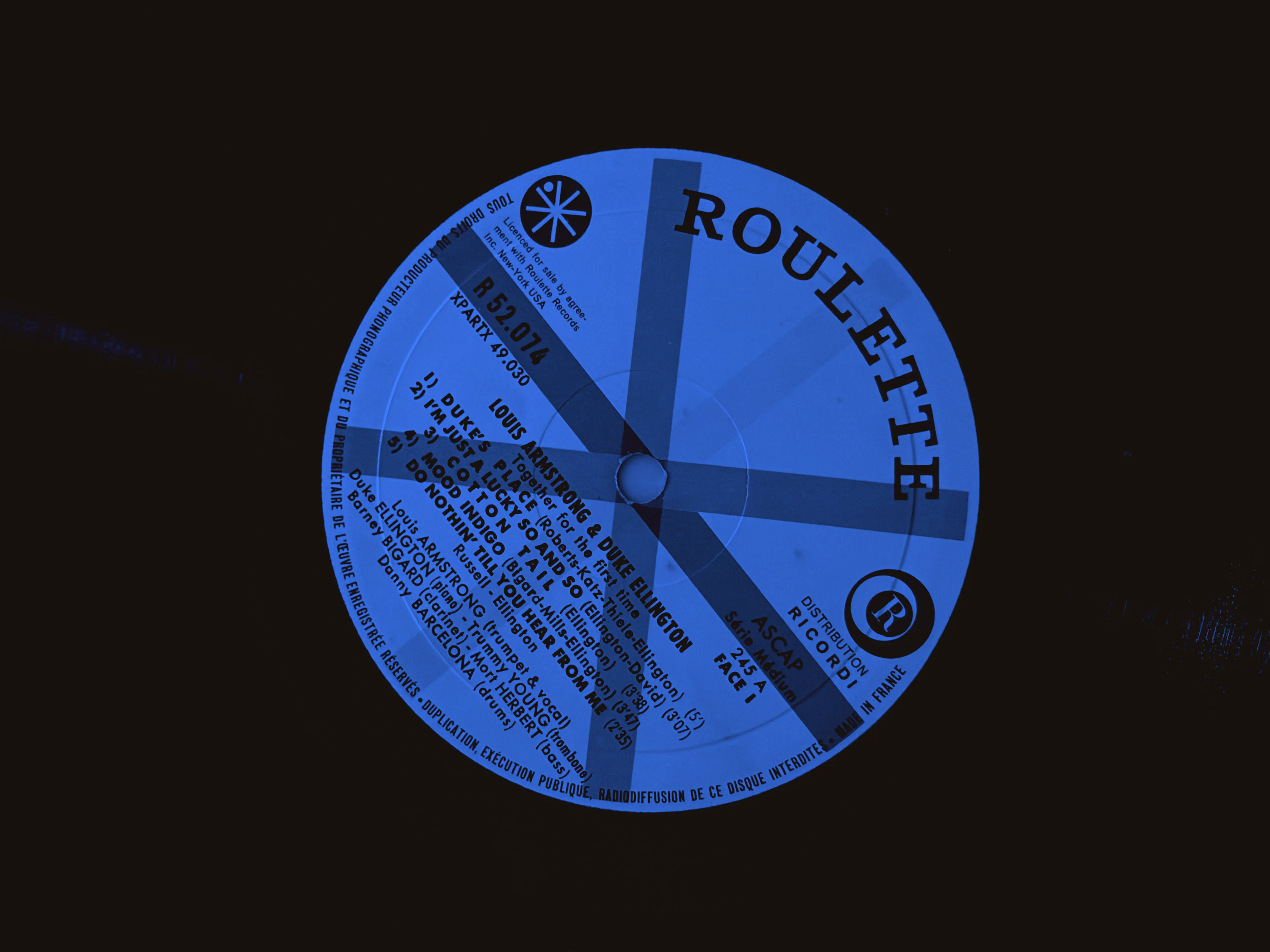
The photo above shows four useful clues on a Louis Armstrong and Duke Ellington record:
- Roulette: the label name.
- R 52.074: the catalogue number on the blue band.
- XPARTX 49.030: the printed matrix number below it.
- Made in France: the manufacturing statement near the lower-right edge.
Keep those identifiers separate. Rights-society initials are another detail, not a manufacturing location. This label says ASCAP and Made in France. Both can be true.
Look closer when it helps
If two candidates share the cover and catalogue number, checking those again will not help. Find the documented detail that separates them.
It may be in the runout, the band between the last music groove and the label. Hold the record under side lighting and tilt it slowly. Copy the marks on both sides, keeping doubtful characters doubtful.
A number printed on the label is not the same observation as one etched into the disc. Compare like with like. The matrix numbers guide explains what else you may find there.
Compare the actual edition
On Discogs, a master release groups editions of an album. Open the individual release and check your copy against it.
- Match the format and disc count.
- Compare the complete catalogue number and sleeve text.
- Check both labels against the photos.
- Compare runouts when needed, allowing for documented variants.
- Look for a detail that contradicts the match.
A missing photo leaves a question. It does not count as agreement. Neither does the sleeve’s copyright date establish when this copy was pressed.
Know when to leave it open
If two candidates still fit, save both and note the missing evidence. The earliest edition, the most expensive one and the first search result have no special claim on the record in your hands.
You can use Kura to work through your collection. A supported match is useful. So is an honest note that you have not settled it yet. You can still play the album.